Showing posts with label Tips & Tricks. Show all posts

The Case for Contractions

From memos and emails to reports, websites and blogs, you should use contractions in all your business communications. If you're not doing so already, you should start changing that today.

Why? 

Modern life and work environments are far more casual than they were just a decade ago. Speech is more casual, attire is more casual, and working relationships are less formal. Online and digital communications are also significantly more casual and interactive than the paper-based communications of the past.

Centered on the Web Revisited

A couple years ago, I wrote about the problems and pitfalls associated with centered text on websites and blogs, so if you're a regular reader, you already know how I feel.

If you're new, you may not, so here's my bottom-line recommendation: Don't do it.


Here's why. 

3 Tips for Crafting Content to Boost Your Business

Demand for original high quality content continues to grow, due to our insatiable appetite for fresh, relevant information. Because not all content is created equal, the internet is awash with material that’s inadequate at best, and inaccurate and incomprehensible at worst.

This makes it fairly easy to stand out from the crowd.

To craft content that boosts traffic, builds your brand and solidifies your reputation, implement these practical tips:


1. Target your audience. Whether you’re generating content yourself or working with a team, take time to pinpoint your target audience. Are you addressing:
  • Long-term customers with experience and expert knowledge?
  • Prospects from diverse backgrounds?
  • Newcomers who are just learning the ropes?
  • Casual readers who have little or no context for the information you’re sharing?
  • Passionate followers who are informed and engaged?

2. Produce content your readers are seeking. Based on search trends, the most consistently popular categories:
  • Inform. Explain products or services and describe why they’re important, useful, irresistible or valuable.
  • Instruct. Demonstrate how to do something using step-by-step tutorials, process models or videos.
  • Influence. Provide context that shapes opinions or helps readers make better decisions.
  • Improve. Highlight products, services and processes that help readers work smarter, live better or both.
  • Inspire. Deliver content that motivates, encourages, supports and stimulates.
  • Impel. Provide information that prompts action such as buying products and services or making work/life changes.

3. Follow a few basic rules. At minimum, make sure every article, news blurb, blog post, product release or marketing piece has a clearly identified audience (customer, prospect, casual reader, etc.) and a defined purpose (inform, instruct, etc.). Then follow these rules:
  • Keep things simple.
  • Be clear, concise and compelling.
  • Write in a direct and active voice.
  • Avoid insider jargon.
  • Revise, refine and rewrite.
  • Proof, polish and perfect.

If quality content isn’t part of your marketing strategy and budget, you’re missing a critical opportunity to grow your business. Luckily, it’s an easy problem to solve. 

You can take the time to develop content on your own or work with a reliable provider like Crossbridge. Either way it's a sound investment, because you’ll have a steady flow of fresh material that attracts traffic, builds customer confidence and boosts your bottom line.

Centered on the Web

There's a strange and rather unfortunate trend emerging in online venues.

From landing pages to websites and blogs, there's an inexplicable proliferation of centered text. It's particularly common on small business sites, where they appear to believe it looks arty or sophisticated.

They're mistaken. There's nothing inherently wrong with centered text, but it's extraordinarily difficult to read, so a little goes a very long way.

Let's look at some examples.

This is an excerpt from Case Studies | 5 Ways They Work for You:
Case studies are remarkably effective marketing and sales tools. They provide a structured way to tell a compelling story, and from the dawn of time, stories have been a potent way to share information or make a point. The best case studies include meaningful data, testimonials, examples and results. It takes time, resources and effort to accomplish this, but it’s worth it.

Here's how the same passage looks when it's centered.
Case studies are remarkably effective marketing and sales tools. They provide a structured way to tell a compelling story, and from the dawn of time, stories have been a potent way to share information or make a point. The best case studies include meaningful data, testimonials, examples and results. It takes time, resources and effort to accomplish this, but it’s worth it.

See the problem? Wading through this relatively short excerpt is a headache-inducing challenge.

Add in the fact that most people scan rather than read, and the absence of a fixed starting point makes this or any text very difficult to review, let alone process and comprehend.

This means if your business blog or website features centered text, it's likely you're losing customers and prospects. In today's fast-aced environment, few are willing to work hard enough to wade through a more than a few lines of centered text.

You can correct or prevent the problem by restricting centered text to these limited applications:
  • Brief titles
  • Brief labels for graphics, images, tables or charts
  • Brief product descriptions 
  • Brief phrases 

Notice the emphasis on brief? With centered text, less is definitely more.

You can completely circumvent this issue and create crisp, clean copy by adopting common business standards, which means you left-align all copy in plain block paragraphs and lists.

In work and life, striving to be centered is a good thing, but on the web, it just doesn't work.

Control the Use of Capitals

Capital letters play an important role in communication. They add emphasis to key words and help readers recognize concepts you find important.

Like many useful things, however, a little capitalization goes a very long way.

I was reminded of this during a recent research foray. A pivotal resource site had high quality content. Unfortunately, the over-zealous use of caps made it very difficult to read, let alone deduce what was important and what wasn't.

'Tis the Season

In a recent conversation, a colleague commented they felt completely unprepared for the coming year.

They described 2014 as so busy and demanding, everyone in the company has remained laser-focused on what has to be accomplished this day, this week or this month. The urgency of now has left little time, energy or brain power to create a plan for 2015.

If you're wrestling with similar challenges, let me offer this ...

Strategy | Pinpointing Product Priorities

It's planning season, that time of year when every organization large or small is struggling to refine its strategic focus for the coming year.

We have in fact been working with a small business client on just such an effort. The big pieces of the plan have solidified and the client is so delighted, they were happy to share a high level overview here.

Let's take a look.

Mastering the SEO Universe

The business world has been buzzing about both recent  and planned SEO changes.

As we all know, Google regularly updates and refines its search engine algorithms. Others do, too, but Google is the 800-lb gorilla in the SEO universe.

Theoretically, Google’s SEO algorithms optimize the speed and quality of search processes and minimize detractors like spam-based sites. 

If you routinely conduct online searches for products, services or reliable, trustworthy information, you can judge for yourself how well these improvements are working. Or not working, as the case may be.

Strategy | Focus on Your Sweet Spot

This has been a hectic year for everyone, and as it races toward its close, everyone is scrambling to formulate a plan for the next one.

Sound familiar? Let me offer a few words that will help you simplify and streamline your approach: Focus on your sweet spot.

It's a fast, familiar and easy way to grasp the big picture and translate it into terms that are meaningful. To you.

Here are a few articles that will help you quickly get started:

Through the years, I've shared many sweet spot strategies and techniques applied in varied ways. To see them all, click here.

Strategy | The Perfect Plan

We’ve devoted a fair amount of space to strategic, business and action planning methods and examples.

Recently, a client sent me his company’s business plan and asked me to take a look at it as part of a larger effort we’re tackling. His goal was to provide valuable context and gain feedback from an objective outside source.

I reviewed the plan with interest and care, and while the actual discussion was more detailed, these are the highlights.

Spotlight | Machining Consulting Services

When Mike Gugger, president and owner of Machining Consulting Services (MCS), decided his company needed a business plan, he contacted Crossbridge for assistance.

Together, we crafted a plan that serves multiple objectives. It describes the MCS vision, mission and goals. It maps a realistic five-year growth plan to guide Mike and his board of advisors. And, it was designed to be shared with clients as well as potential investors.

Economy | What Employers Really Want


What Employers Really Want took the first detailed look at the hiring process from the employers’ perspective.
                                   
The goal was to explain the inside viewpoint to help job seekers understand and navigate the job search to find the right job – and right employer – for them.

Ben on Business | Industry

Industry. Lose no time; be always employ’d in something useful; cut off all unnecessary actions. BEN FRANKLIN
When Ben Franklin decided that it was not just possible but desirable to seek perfection, he drafted a list of 13 virtues.

These virtues or behaviors defined the scope of his personal self-improvement program.

Industry is virtue number six. To Ben, industry was a verb, an action not an entity, and throughout his life, he practiced his own advice.

Ben on Business | Seeking Perfection

It’s one thing to conceive of an idea, another to put that idea into action.

Ben Franklin (1706-1790) was an entrepreneur, inventor and statesman – a man with big ideas and big accomplishments.

Along the way, he determined the pursuit of perfection was one key to success in life and business.

How did he translate such a “bold and arduous” idea into action? One step at a time.

Strategy | The Power of a Game Plan


Early in May, Steve Forbes and John Schlifske visited a handful of cities to talk about “The Power of a Game Plan.”

You’re probably familiar with Forbes, the chairman and editor-in-chief of Forbes Media.

You may or may not be familiar with Schlifske, the chairman and CEO of Northwestern Mutual.

Strategy | What's the Value of Focus?


What’s the value of having a clear focus?

That’s a very good question, one that’s difficult to evaluate.

Luckily for us, Pareto, the Italian genius behind the Pareto Principle (or the 80-20 Rule), provides some clues.

Strategy | The Power of Vision

A colleague and I have frequent, often vociferous discussions about the power and importance of having a defined vision.

We disagree on a few of the fine points, but agree on the big issue:  A clear, precise and well-defined vision is essential to success.

This is true for organizations and individuals.

Aristotle's Success Strategy

It’s true. There’s nothing new under the sun.

Take the need to plan for success, for example.

We struggle with this challenge today, and as nearly as I can determine, that struggle has gone on for at least 2300 years. Here's the proof.

Strategy | Find Your Future Sweet Spot

Many organizations are trying to figure out how to move from where they are today to where they want to be in the future.

They’re working to redefine their company and get positioned for the next stage, whatever that might be.

If that sounds familiar, you might want to pinpoint your sweet spot from a fresh perspective.

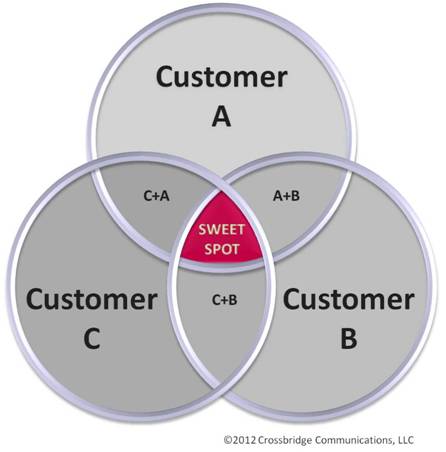
Strategy | Define Your Customers' Sweet Spot

We recently posted a short series of articles about using Venn diagrams to find your sweet spot.

Both individuals and organizations have sweet spots, that zone where people and organizations are able to maximize strengths and minimize weaknesses.

Our sweet spot strategy applies to customers as well.

Related Posts Plugin for WordPress, Blogger...